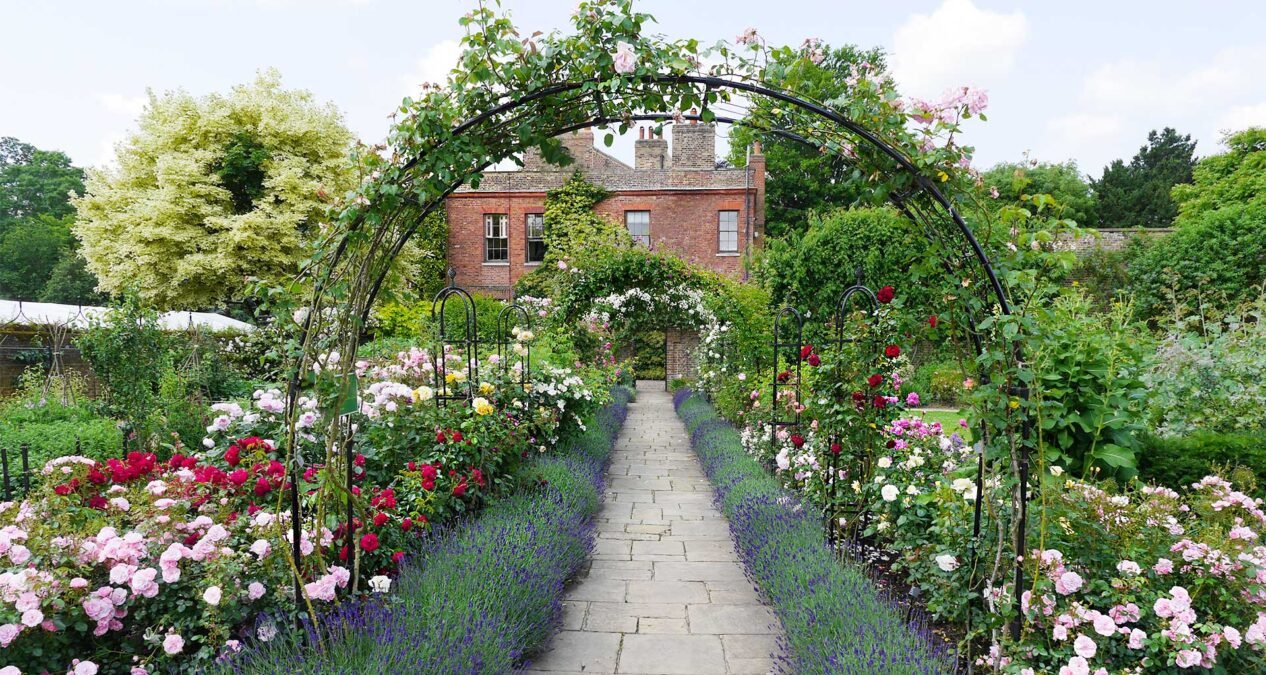

There is something quietly theatrical about a garden arch. Unlike a gate, which commands, or a fence, which merely delineates, an arch invites. It frames a view, promises a journey, and transforms an ordinary passage through the garden into something approaching ceremony. For those of us who think carefully about what our gardens are actually for — not just how they look in photographs, but how they feel to move through, season by season — the arch occupies a unique and undervalued position in the designer’s toolkit.
British gardens have long understood the arch’s power. The great landscape estates of the eighteenth century used it to punctuate long walks, to create moments of compression before opening out into borrowed views. But you do not need a Capability Brown canvas to exploit what an arch can offer. In a modest suburban plot, a single well-placed arch can entirely reorganise the way the garden is experienced, turning a flat rectangle of lawn into something with depth, sequence, and surprise.
Structure First, Plants Second
The mistake many gardeners make is to think about an arch primarily as a support for climbing plants, when really the climbing plants should be considered secondary to the arch’s structural role. The arch comes first. It creates a threshold — a psychological boundary between one area of the garden and another — and that boundary exists whether it is clothed in rose or left entirely bare.
This is not to minimise the extraordinary contribution that climbers make. A mature Rosa ‘Compassion’ or ‘New Dawn’ flowering over an arch in June is one of the most heart-stopping sights British horticulture has to offer. But the arch beneath those roses is doing structural, spatial, and emotional work that the roses alone could never do. Understanding this changes how you choose and position an arch, and it is why the decision deserves considerably more thought than a quick scan through a catalogue.
When selecting an arch, consider the view it will frame rather than just the space it will occupy. Stand at the point from which the arch will most often be seen and look through it. What lies beyond? Even if the answer is ‘the compost heap’, a well-placed arch draws the eye and creates the illusion of depth and destination. The height and width of the opening matter enormously: too narrow and it feels constricting; too wide and it loses its framing quality entirely.
Materials and Their Meanings
Garden arches are available in a considerable range of materials, each of which brings its own aesthetic associations and practical demands. Timber remains the most sympathetic choice for most British gardens, sitting naturally within planting and weathering over time into something that looks as though it has always been there. Softwood structures are the more affordable option but require regular treatment with preservative if they are to last; hardwood — oak in particular — develops a silver-grey patina and can remain structurally sound for decades with minimal intervention.
Steel and wrought iron offer a different character entirely: sharper, more architectural, better suited to formal gardens or contemporary schemes where clean lines matter. A painted steel arch in the kitchen garden, supporting espalier fruit or vigorous climbing beans, reads quite differently to the same structure in a cottage border — and that is as it should be. Materials should belong to their context.
Galvanised steel arches have become popular for their longevity and relatively modest cost. Powder-coated in black or dark green, they can be genuinely elegant, though they require the right planting to soften what can otherwise feel rather industrial. For a broad overview of what is currently available across all material types, Dobbies carries a well-stocked range of arches and arbours worth browsing before you commit to a particular style.
The Arbour: A Room of One’s Own
The arbour is, in a sense, the arch taken to its logical conclusion: rather than merely framing a passage, it creates a destination. The word itself derives from the Latin ‘herba’, via the Old French ‘erbier’ — a place of grass or herbs — and the concept has been part of garden design since at least the medieval period, when herbers provided shaded retreats within the larger garden.
The National Trust’s guide to visiting and exploring historic gardens is a wonderful resource for anyone interested in understanding how great British gardens have used structural features like arbours and arches across the centuries — seeing them in their original context is genuinely illuminating when it comes to making your own design decisions.
The modern garden arbour ranges from simple paired arches with a seat between them to elaborate timber structures with slatted roofs, side panels, and enough presence to anchor a garden entirely. At its best, an arbour does what the finest garden features always do: it gives you somewhere to sit that feels removed from the ordinary world, enclosed without being claustrophobic, connected to the garden while offering a particular and privileged view of it.
Positioning an arbour demands careful thought. It should feel as though it belongs — neither plonked arbitrarily on a lawn nor tucked so far into a corner that it loses its relationship to the rest of the garden. Ideally, it sits at a natural pause in the garden’s circulation: at the end of a path, at the junction of two different areas, or with its back to a boundary so that it looks out over the main planting. The best arbours have a slight sense of enclosure behind and generous openness before.
Planting to Clothe: A Few Reliable Choices
The choice of climber for an arch or arbour is one of the most pleasurable decisions a gardener can make, and one that deserves more than impulse. For continuous interest through the growing season, consider layering your planting: a rose for early summer fragrance and spectacle, an early-flowering clematis to precede it, and a later-season clematis to continue after the rose has finished its main flush.
For arches in particular, roses that produce long, flexible stems are far easier to train than those with a stiffer, shrubby habit. ‘Bobbie James’, ‘Francis E. Lester’, and ‘Wedding Day’ are vigorous ramblers that will cover an arch generously but require firm annual management to stop them becoming impenetrable thickets. For those who prefer something more restrained, the repeat-flowering climbers ‘Darcey Bussell’ and ‘Alnwick Castle’ offer a more manageable scale with exceptional fragrance.
Wisteria is perhaps the most dramatic option of all, but it demands a very robust structure — timber arches in particular must be both well-anchored and of sufficient diameter to bear the weight of mature growth. A well-supported wisteria in full flower in May is simply one of the great sights of the British garden year.
Afterthoughts on Permanence
One of the most important things to understand about a garden arch or arbour is that it is, in garden terms, a semi-permanent fixture. Unlike a pot or a piece of furniture, it commits you to a particular spatial arrangement and a particular planting scheme. This is not a counsel against purchase — quite the opposite — but it is an argument for choosing thoughtfully.
A well-chosen arch or arbour, properly maintained and generously planted, will give its owner decades of pleasure. It will change the way the garden is experienced, create shelter and shade where there was none, and provide a framework around which the rest of the planting can organise itself. In a garden full of ephemera — annuals that come and go, perennials that fluctuate, shrubs that need replacing — the arch offers something rarer and more valuable: continuity.
Choose well, plant boldly, and give it time. A garden arch is not something you live with for a season; it is something, at its best, that comes to define a garden entirely.